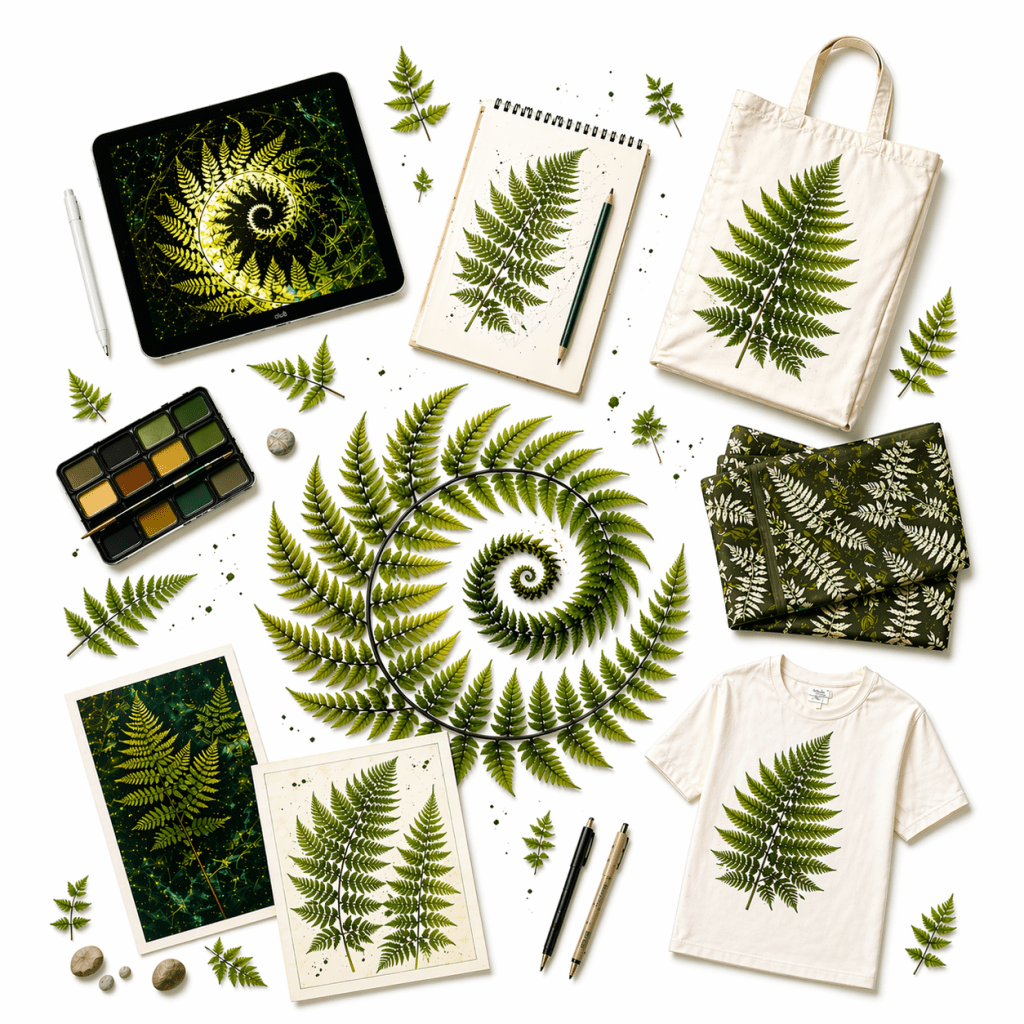
My practice is rooted in an engagement with the generative logics of non-flowering plant systems, specifically the morphological and reproductive behaviours of ferns. Rather than approaching the fern as image or motif, I treat it as a procedural model, a living algorithm through which form, variation, and distribution emerge.
Central to this work is an exploration of the rhizome as both structure and method. Drawing loosely on ideas associated with Gilles Deleuze and Félix Guattari, the project resists hierarchical composition in favour of lateral expansion, where each output functions as a node within a continuously mutating network. Images are not produced as discrete objects but as moments within an unfolding system of propagation.
The practice operates through iterative prompt-based processes using accessible machine learning tools, including Stable Diffusion and ChatGPT. These tools are not positioned as authors, but as substrates through which a set of constraints, repetitions, and deviations are enacted. The resulting images are less “generated” than cultivated, emerging through cycles of selection, mutation, and recombination.
A key conceptual framework within the work is the notion of the fern life cycle as a dual-state system. The visible image, analogous to the sporophyte, is only one phase within a broader ecology of production. Beneath it exists a less visible layer of prompt structures, discarded iterations, and latent variations, which function as a kind of digital gametophyte. This hidden layer is essential to the work, though rarely directly encountered.
The unfolding of the fern frond, or fiddlehead, provides a temporal model for the practice. Works are developed in sequences rather than as singular compositions, allowing form to reveal itself gradually through successive iterations. This process resists the notion of the finished image, instead privileging emergence, latency, and partial resolution.
Materially, the project extends across multiple outputs, including digital prints, textile patterns, and garment-based works. These are understood not as endpoints but as surfaces onto which the system temporarily resolves. The translation of generative processes into reproducible formats such as clothing introduces a tension between organic growth and industrial repetition, a friction that the work deliberately inhabits.
Underlying the practice is a commitment to working within constraint: low-cost tools, limited palettes, and reduced formal vocabularies. These limitations function not as restrictions but as environmental conditions, analogous to the shaded, resource-limited ecologies in which ferns thrive. It is within these constraints that the work finds coherence.
Ultimately, the project proposes a shift from authorship to cultivation. The artist does not compose the image in a traditional sense, but establishes the conditions under which images can emerge, proliferate, and mutate. In this way, the practice positions itself as a form of ecological participation within a computational environment, where the boundaries between system, tool, and author remain deliberately unstable.
 FERN DESIGNS